
Looking back, the first few months of this summer feel to me like a slow escape from the terrible vortex of US politics. This happened in July in China, not in Germany.
Berlin is obsessed with Germany’s new government and with Trump, triggering endless painful questions about Columbia etc etc. Precious little else registers. Plus Berlin is home. It induces no sense of dislocation or puzzlement. It offers the comfort of the familiar, not a “reset”.
China is different. The experience is not so much that of jumping from a frying pan into the fire as jumping from a frying pan into a very busy swimming pool. Its a genuine relief, but there’s no time for day-dreaming. It’s time for “heads up”.
Looking back I realize that the first piece I wrote for the FT after the Tianjin summer Davos was still very much caught up in the comparison between the Trump administration in its “Alligator Alcatraz” moment and the shock of arriving in China.

If people have said I was excessively kind to China in that piece, my response is that it really wasn’t about China at all. It was really about seeing the ghastliness of America in a Chinese mirror. You are barely aware of the mirror itself. What you see is the face reflected.
Backlit by the lurid mayhem of the US, the face that China officially presents to the world seemed like a retro-future projection of the Blairite/Clintonian 1990s.
Admittedly, seeing Tony Blair up close for the first time at a lunch in Tianjin may have helped to trigger this “back to the future” moment. (NB: This was before his outfit’s consulting work on the ethnic cleansing of Gaza was revealed).
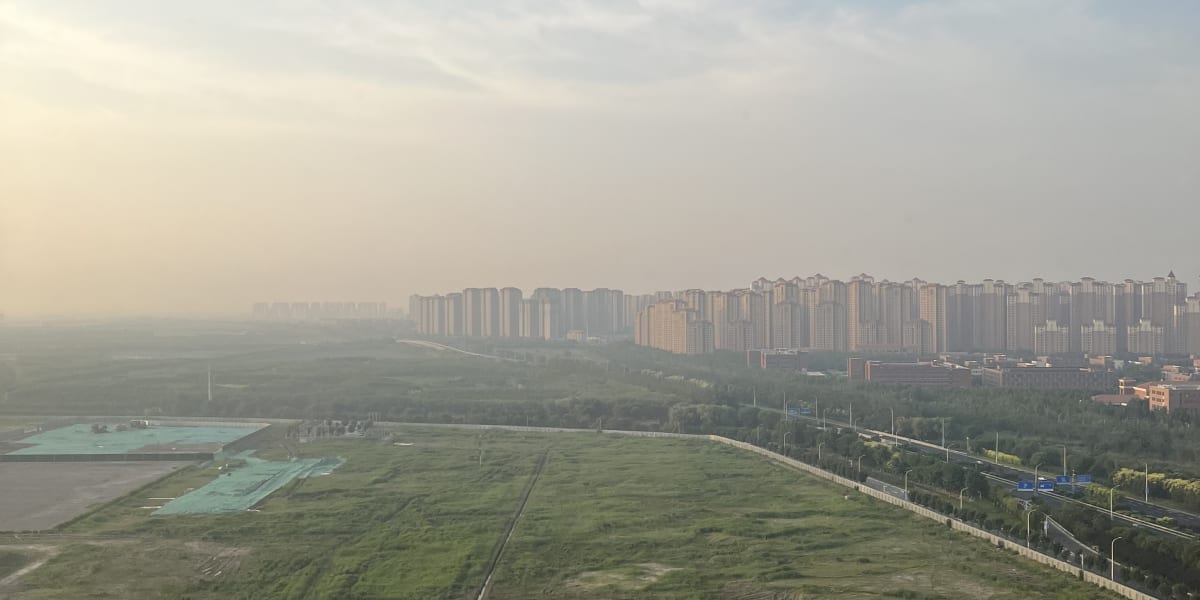
In fact, as far as China was concerned, the experience of the Tianjin conference center, where Summer Davos was hosted this year, was a rather shocking one. As a result, I am more open to the Michael Pettis critique of excessive investment than I have ever been before. The impression of the vast, empty buildings of the conference complex was truly Pharaonic, especially when contrasted with the exhausted delivery drivers on the ramps outside collapsed in the summer heat on their mopeds and scooters.

I really began to learn things about China. Or at least it felt that way.
And, as the experience sunk in, through hours of conversations with officials and journalists and think tank people, friends including many members of the wonderful Chartbook China team, more or less public gatherings, taking Chinese lessons face to face, pillow talk, gallery visits, outside walks when the heat permitted, road trips, “hanging out”, as all of this piled up, the contrastive reaction began to fade.
I am not saying that one can escape “white guy goggles”. That would be silly. But what does happen is that your interests and self-identification and self-location shift. I found myself thinking about the US less and less. By the time we were doing events in independent bookstores in Chengdu I was joking about the therapeutic value of the Great Firewall causing me to dose my internet exposure, a kind of digital detox provoked by worrying about roaming charges and VPNs.

This doesn’t mean that you lose track of your train of thought, but your thought takes on a different focus and direction. And that’s especially the case when the police and some rather ominous looking guys in plain clothes show up half way through the event and start filming everyone.
The talk I gave at CCG about China and the Global Green Transition was one moment in this process, where I feel as though I found something to say about China that at least somewhat surprised my Chinese audience. The result was more interesting conversations with Chinese journalists including a particularly sharp colleague from the Global Times.
Thanks to the great Zichen Wang of Pekinology for setting this up.
Zichen Wang, Research fellow & Director of International Communication, Centre for China and Globalisation (CCG)

Here, lightly edited, is the opening salvo of the talk:
It is easy, when talking about China’s industrial development, to fall into a sense of hyperbole—that we may, in some senses, be exaggerating what’s going on. But in this particular case, there is, in fact, a need to double down on the hyperbole. One of the challenges of thinking about China’s economic development—material economic development, especially the energy side of China’s economic development—is to find the terms to do justice to the radicalism of what has happened, and therefore also the challenges that lie ahead. … what this requires us to do is to pinch ourselves. To shake ourselves out of complacency and everyday banality.

This graph, which comes from Our World in Data—a very familiar source—is as staggering a graph as I could possibly put on this board. But most of the time we look at it and respond by shrugging: “Oh yeah, of course, that’s what’s going on.” But look again!
This is coal production in recorded human history. This is species being, in the Marxian sense—all humans who’ve ever lived. This is how much coal they have ever mined. And I don’t need to tell you, but coal is a really good proxy for modern urban industrial development. Without it, no Industrial Revolution, no industrial capitalism, no fully organic surplus value production and exploitation, as Marxian texts laid it out in the 19th century. If you use this metric, it is impossible to avoid the conclusion that the history of our species on the planet—I do not exaggerate, this is all the numbers there are; there’s not some other bit of unrecorded energy history out there that isn’t captured here—it falls into three phases. The phase up to 1750, where human societies relied largely on a somatic, biological energy regime—firewood, human power, animal power. The period between 1750 and the end of the 20th century, which was the classic industrial regime, started by the British, copied by the Germans, the Americans, the Japanese, the Soviet Union, by China in the phase of development in the ’50s and ’60s.
… climate politics at a global level was framed around in the 1980s and 1990s, when we thought we knew what the climate problem was. It was American-centred. It was Exxon. It was Texas. It was Europe. It was Krupp. It was the Ruhr. It was Europe. It was Western industrial history. But then comes the third phase of the history of global economic development.
This is within literally all of our lifetimes. Everyone in this room is old enough to be part of this history, because it starts almost on the dot of 2000. And it is this explosive curve here.
Again, let me just re-emphasise: there’s no “out” here. There’s no other bit of history we haven’t considered. This is all of fossil fuel history as summarised by the coal variable, and you can see what China did to that history in the last 25 years. It’s a sudden, utterly radical break with all previous human history. It’s a break with China’s previous history. China had heavy industrial development in the Mao period, which was heavy; it was large; it was incredibly inefficient. In the early phase of “opening up and reform” under Deng Xiaoping, there were two radical policies: one-child policy, and the other radical policy was energy efficiency. … in that period, China grows without exploding the fossil fuel envelope through the late 1990s. And then, within all our lifetimes, something completely mind-blowing begins to happen in China. Heavy industrial production and energy consumption go vertical in a manner unlike any previous moment in recorded human history.
Well-meaning people in the West will often say: “Oh but China’s emissions are actually down to the West offshoring its pollution”. Of course there was some of that. But it is a minor part. That’s maybe 10 to 15 per cent of the Chinese growth. Most of it is Chinese urbanisation. It is the building of buildings like this—the office building we are currently in. … It is the construction of China’s massive new cities, the urbanisation of new migrants—of 500 million people—and the modernisation of the entire Chinese housing stock in the course of 30 years. … the remaking of Chinese society as urban society has world historic dimensions … almost 90% of the apartments that Chinese people live in today, all of you lived in and grew up in, were built since the 1980s. As a European, that’s unimaginable. … In China, everyone is living in a churned, remade urban modernity. And the basic argument of this paper—what I’m going to say—is that that changes the climate policy game.
Thanks to Zichen and the CCG team you can read the rest (in unedited form) here.
Shaking ourselves out of complacency, seeking to overcome the West-sizing (i.e. the measuring of much bigger and more dramatic Chinese things by the modest yardstick familiar from the West), checking the “oh well yes, thats just China” reaction, was also the theme of the conversation with Kaiser Kuo at his idyllic band camp in the mountain town of Shaxi.
The last time Kaiser and I recorded, I think, was in a nighttime hotel room in Dalian. This conversation felt very different. I’ve edited this section of the transcript to make it more digestible. It was an exciting conversation, a slightly “out of body experience” and things ran away from me from time to time. This is one of the concluding exchanges:
I started seriously thinking about China in the wake of writing Wages of Destruction. I then embarked on writing that book, Deluge, (in 2006-7) about the aftermath of World War I, when America emerged as essential to world affairs. What do we mean by “world affairs”? (The term was coming into widespread use at the beginning of the 20th century) You mean a world which is, of course, the European empires, but above all, it is already a world to which the destiny of China is crucial. That was the moment where I suddenly kind of joined up the dots in my own personal history and (finally and belatedly) realized there were a generational challenge for anyone in the West who is writing the history of “modernity” or attempting to think “the modern”. There just is no reasonable way of doing that anymore without making a serious effort not only to think about China, but to think outward from China.
After Deluge, Crashed was a testimonial to that.
I addressed this recently in Chartbook riffing on the work of the geographer Jamie Peck, who was applying Stuart Hall’s idea of conjuncture to the question of China’s political economy. China is one of the master keys to understanding modernity. I would be tempted to say that it is “the” master key. Except that I am too much of a pluralist to want to claim that there is a single master key.
We should be profoundly skeptical about any application of cookie-cutter social science models to China. Not just on general methodological grounds. But because of scale and historic weight. … After all, the entire dataset of middle-income cases is like six Chinese provinces. … This is the biggest laboratory of organized modernizations there has ever been or ever will be at this level organization. So, that changes this game. All of our previous social theoretic theorizing was a prelude … the Industrial History of the West was a preface to China’s industrial history. That’s the message that comes out of energy history, for instance. And one of the reasons I’m fascinated by the climate problem is it’s a way for me of writing a book about China. It’s a way because this is the domain in which China has not just overtaken, but just, frankly, blown away every conceivable alternative center of relevance in the last twenty-five years.
And so the energy transition is essentially a China problem at this point, as we were saying, 75% of all renewable energy projects right now are Chinese, 33% of global emissions are Chinese. And the vast preponderance of the growth in emissions has been Chinese. … to give an example, concrete example of how thinking about China conceptually changes what we think a problem is. We thought of the energy transition as a static zero sum, how do I replace A with B. Well, China has shown us that, instead, “development is the master key”, growth is the master key to understanding how we bring about really rapid and a change in energy technology. … And that’s, of course, far more applicable to the rest of the world. There’s no point in talking to India about zero sum substitution, telling the Indians to shut down their coal-fired power stations when their per capita energy consumption is a very, very low levels is absurd. And it’s even more absurd to tell African countries they shouldn’t have gas infrastructure. Tell African countries to model that economic development along lines prefigured by Europe and to prescribe and gas infrastructure … so I think that getting beyond thinking of Chinese growth either as an instance of growth in general or as some sort of exception to the general rule is key. What we have to grasp – and this is where the climate example helps us – is that China’s growth is the central dynamic of world development. It is not an instance. It is not an exception. “It is the ball game”. … At one level this is banal. And yet, actually, when you look in detail at Western discourse, again and again and again, you see folks shying away from this realization. There’s an unwillingness to face this reality. Why? Because it’s disempowering, right? I mean, what it really means is this is the material dethroning of the West as the central driver of world history. This is really what the provincialization of the West looks like. And you don’t have to spend a lot of time in China or go to a lot of places to see what that means in terms of physical manifestation, just the footprint, physical infrastructure here across the vast spaces of this country, the massive population.
Kaiser: Yeah. Absolutely staggering. And yeah, it’s a source of great frustration to me. I mean, I have paid some attention to your reception in the world at least of western, so-called China watchers, and nobody is treating you with hostility as a wide-eyed naive foreign interloper. It’s not like, as a group, we’ve been particularly unwelcoming. A lot of us working on China, we go through a confidence curve of sorts. We start out very unsure, with a lot of epistemic humility, I would hope, then we become kind of dangerously confident. And eventually I think we arrive at or we ideally arrive at an informed humility. Where are you now on this arc when it comes to making strong claims about China? Where do you feel like you are?
Adam: Well, see, my claims, are absolutely at the humility level, and there really isn’t anything more humbling as learning Chinese as an adult. This is my fourth language. But, this is an entirely different experience. It’s like learning to read again. It’s not like learning about language. It rewires your brain.
Kaiser: We were just talking about that
As a tall white guy, as you settle into being in China, you begin to normalize certain things. One of the most banal is that whilst in modern China you are surrounded by all the familiar brands and accoutrements of modernity. There is one major difference. Those brand images and appeals are not directed to you. You are quite suddenly “alone”. There is no one else around who is “like you”. You can walk for hours, even in Beijing, and not see another foreigner. You become used to being a giraffe-like presence, gangly, towering, taking up too much space, weird looking, a zoo specimen.
Occasionally jarred back into recognizing this as a novel experience, I asked DeepSeek to compile some data on foreign populations in major Chinese cities. It produced these figures, which, from experience and from specific searching on Chengdu for instance, seem to err on the high side.

Whichever way you slice the data, these are astonishing numbers and should reshape the way we think about urbanism and globalization more generally. Urbanization in China, at least at this point, does not go hand in hand with global diversity.
Once again, China is not just another “case”. Nor does it make sense to think of it as an exception to a “global rule”. China’s cities are the most gigantic experiment in urbanization in history. If anywhere has a claim to define the “norm” of urbanism it is China. But perhaps what China teaches is that to posit a global norm of urbanism is a mistake. What we need to think in terms of is UNEVEN and combined development.
China in 2025 may have as many as 160 urban centers with a population of more than 1 million. Of these 18 are megacities with 10 million inhabitants or more. For sake of comparison the US can claim to have no more than ten urban areas with a population of one million! Being in China makes you realize how profoundly anti-urban America is. There are only two US conurbations – NY-New Jersey and LA – that would qualify as megacities. On sheer scale neither would qualify as Tier 1 in the Chinese rankings. For further comparison, the EU counts 39 urban areas of over 1 million inhabitants but only one city-region, Paris, with a population of over 10 million.
There is not a single city in either Europe or the US that can compare to the awesome scale of the largest Chinese conurbations. The closest thing in the Western hemisphere would be Mexico City. Notionally Mexico also has a GDP per capita quite comparable to that of China. But, anyone who has been to a major Chinese city and Mexico City in close succession will be able to rattle off the significant differences.
So, what happens to our view of the world if we think the connection of globalization and urbanization outwards from China. That was the question that animated the most recent FT column.

In that short piece I doubled down on the population “diversity” point by overlaying it with the question of the Chinese social media and internet world.
If you even dip your toe into the Chinese internet you quickly realize that it isn’t censorship or the Great Firewall that are the most powerful forces closing it to the outside world. They matter of course. But the idea that but for the prohibitions of the Chinese regime, there would be one “flat” internet and that it would look like the Western version, is deeply implausible. First and foremost the Chinese internet is the Chinese internet due to self-closure. That self-closure is driven by language barriers and the inward turned “gravitational pull” of a gigantic, fast-moving and endlessly fascinating national media system.
In the FT piece, prompted by a fascinating conversation I had on the trip back to Europe in Singapore, I suggested that the idea of “dual-circulation” was an apt way of thinking about the form that globalization takes in China today.

Standing further back, I’m left wondering whether the problem is not that as far as the modern period is concerned, we have so far thought globalization first through the global condition framed by the British Empire project (Geyer and Bright, Darwin) and then in the form given it by US hegemony. From tiny Britain to the “continental” United States, was one major step. America’s nationalism – in politics, culture and economics – is one major difference between the two phases. How much more radical does this become when the driving force of globalization is a nation state of China’s scale and cultural-linguistic peculiarity? We simply have no experience of any such system. The massive Chinese nation state has been progressively forged out of the maelstrom of violent experimentation between 1911 and 1949 by the PRC. In material terms it was given huge new energy by the extraordinary scale of economic development since the 1980s (at which point the train of thought connects to the idea of Chinese national economic development I sketched in the Whither China piece of June ahead of the trip).
The challenge is to think through what globalization means when its most dynamic driver (some may want to argue with that) is not the British Empire, or US hegemony, but China – a huge, highly nationally specific, nation state and national economy still in development and very much under the control of a Communist Party that whilst actually dominated by quite conventional developmentalism insists on tracing its lineage by way of 1989, back to the epoch of war and revolution. Inside China, “dual circulation” seems like a good description. But what does this do to the world that is connected to China?
Thank you for reading Chartbook newsletter. I hope you find that it offers valuable insights, interest and provocation. What sustains the effort are voluntary subscriptions from paying supporters. If you are enjoying the newsletter and would like to join the group of supporters, click here:
link