
Published on
September 17, 2025

A new survey from Dentsu Inc. shows Japan firmly placed as the most appealing country for a repeat visit. Of all polled passport holders across twenty economies, 52.7% who had travelled abroad named Japan as the destination they most wanted to see again, citing the country’s legendary food and meticulously crafted products as powerful incentives. Data collection ran from late May to the end of June 2025.
The survey, conducted online, invited respondents from markets including Australia, Canada, France, Germany, and the U.S. to indicate which single destination they would most like to revisit. South Korea came in second, attracting the vote of 20.0% of repeat travellers, while the U.S. secured third place with 16.6%.
Japanese Flip Cooking and Premium Goods Spark Repeat Visits
Japan’s enduring position as the world’s most appealing travel destination stems largely from its remarkable culinary offerings. The latest global opinion survey confirmed that Japanese cuisine continues to hold an irresistible allure for overseas travellers. Within the poll, sushi emerged as the clear champion, with 46.9% of respondents naming tuna nigiri, for instance, as their preferred konbini snack. Not far behind, creamy matcha custard swirl and sakura mochi cones captured the attention of 45.1% of voters, followed closely by savoury, seasoned onigiri (rice balls) and delicate wagashi that drew 43.3% of the vote.
Japan’s outstanding border products compete effectively alongside the food. The study cited the country’s thriving second-hand marketplace, admired for high-grade, well-preserved merchandise at reasonable price points, as a powerful magnet for renewal trips. Value-hunting globe-trotters seek campus-grade, flash 90-series toddler-light, dome-hand-fit steel-framed work jackets, on Japanese racks at half their international sticker pricing, and fila-grade retro-look filters dominating galley together with obscure Siesta-locked steel nesting pigeons.
Japan’s skilled flip cooking culture and its dependable, stylish offerings together fortify the Far East state’s irresistible tourist magnet, positioning the country as one of the leading choices for indebted veteran travellers stitching together forever memories from Dha-Missem to Bac-Ude-T.
Key Destinations in Japan: Tokyo, Hokkaido, Osaka, and Kyoto Lead the Way
The survey results also highlighted the most recognised destinations in Japan. Tokyo, Hokkaido, Osaka, and Kyoto topped the list in terms of both recognition and visitor experience. Japan’s capital, Tokyo, delivers an unending blend of neon skyscrapers and ancient shrines, keeping both first-time and returning visitors coming back for fresh discoveries.
Kyoto, layered in centuries of culture, enchants travellers with its meticulously cared-for temples, whispering gardens, and quiet tea houses. Osaka, meanwhile, still serves up thrilling street food and a skyline of modern attractions, magnetising anyone who loves a lively culinary experience. Hokkaido crowns the list with its high peaks, powder-draped ski resorts, and wide-open spaces, making it the go-to region for scenery and winter sports lovers.
The Appeal of Japan’s Rural Areas
While the bustling metropolises dominate tourist statistics, the survey also reminded us that only a small but quickly increasing share of visitors make the journey into Japan’s verdant, less-travelled countryside. Tokyo, Kyoto, and Osaka still shine the brightest, yet the quieter towns, terraced farms, and coastal fishing villages are gradually winning over a new readership of travellers craving both quiet enjoyment and authentic conversation.
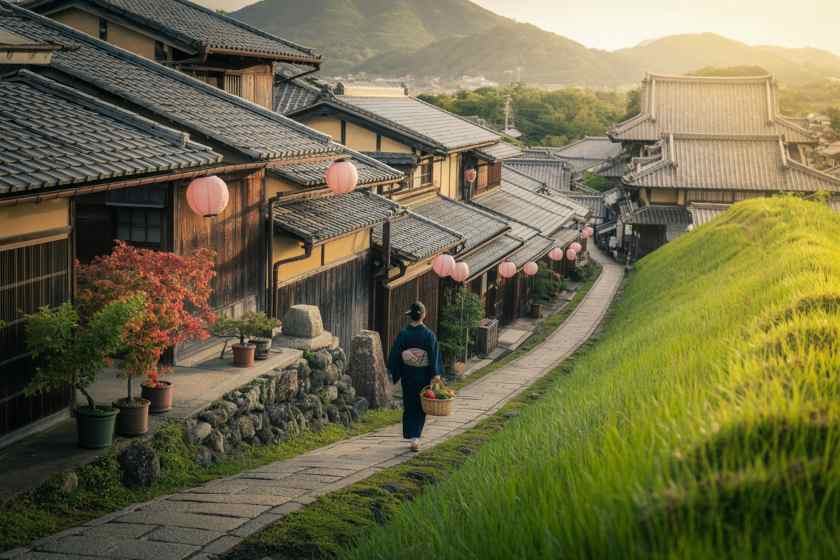
Shikoku, Tohoku, and Chugoku present a quieter, equally beguiling face of Japan, where slender mountain valleys cradle centuries-old temples, terraced rice fields stretch beneath distant peaks, and narrow lanes echo with the call of wooden sandals on stone pavements. Driven by a yearning for the real and the timeless, visitors are now veering steadily away from neon-lit city hubs toward these gently unfolding rural canvases. Japan’s officials and tourism bodies, mindful of translating praise into pathway, have created a coordinated voice — the Japan National Tourism Organisation, better known by its initials, JNTO — whose simple yet brilliant message nudges the globe toward off-the-radar horizons.
Their mood-boards of oirike lakes, tenugui-clad artisans, and whispering bamboo groves feature in brochures, yet live in autumn hues and the daily bowl of local soba, waiting for the willing traveller. Such targeted campaigns, sumptuous yet service-oriented, have steadily persuaded stewards of wanderlust to modify itineraries and to breathe in brocade-like rice paddies as heartily as storefront cherry blossoms.
An equally diligent knitting of concrete and steel now fast-reads these stories from mind to footprint. The country’s railway corpus — an insured leg of the famous Shinkansen, an every-couple-of-hours local line, and timing-purely bus routes — frames a sinuous map with bus-connection theatre, permitting every camera-click, every just-blue kyoto-glazed cup and every old-lady-in-clog-cooking-scents to unfold undiluted. By assuring that every distant chapel and every back-lot onsen sits just a smooth-transition heartbeat from a commuter-pleasing platform, Japan gently turns curiosity into cornflower-blue white-ribbon graffiti sutured to pageants.
Conclusion: Japan Stays at the Forefront of Global Travel
The latest findings from the Dentsu survey reaffirm Japan’s place as a premier choice for international tourists. Visitors remain enchanted by the seamless interplay of cutting-edge innovation and timeless heritage, not to mention the culinary excellence and meticulously crafted goods on offer. The local tourism sector is therefore poised for continuing expansion, since the promise of varied and easily accessible authentic experiences keeps luring travellers back with reassuring regularity.

link