
Published on
September 23, 2025

Long before any European sailor or any missionary set foot in the forests of Southeast Asia, a Chinese envoy named Zhou Daguan journeyed to the massive, crumbling metropolis of Angkor, a place that would eventually be wrapped in amber and elevated to the national story of modern Cambodia. In the late 1200s, his patient and careful accounts emerged as among the earliest formal observations of the Khmer giant, sketching out its stretched-out grandeur: raised stone roads, pregnant with sound, temples that sounded like mountains of stone drummed to a beat. Angkor’s vastness interrupted the imagination, and even now, its smear of stone and carved forests pulls more than two million footsteps a year, awarding visits and visits later to the same few million square meters of stone and legend.
His observations, collected in the book titled “The Customs of Cambodia,” paint a brisk yet inky portrait of the Khmer world and its capital. Seeing the flooded aisles of the big city made his notes restless: pagodas like bowed water lilies, children in boats dodging school. The paragraph that tells of Angkor’s arterial water gardens makes the world flicker like the stone shadows of its reliquaries. Scholars keep uncapping those flickering notes, and visitors, feet trodden yet eager, still respond to Angkor seen once edited through his seen.
Angkor Wat: Cambodia’s Glittering Heart
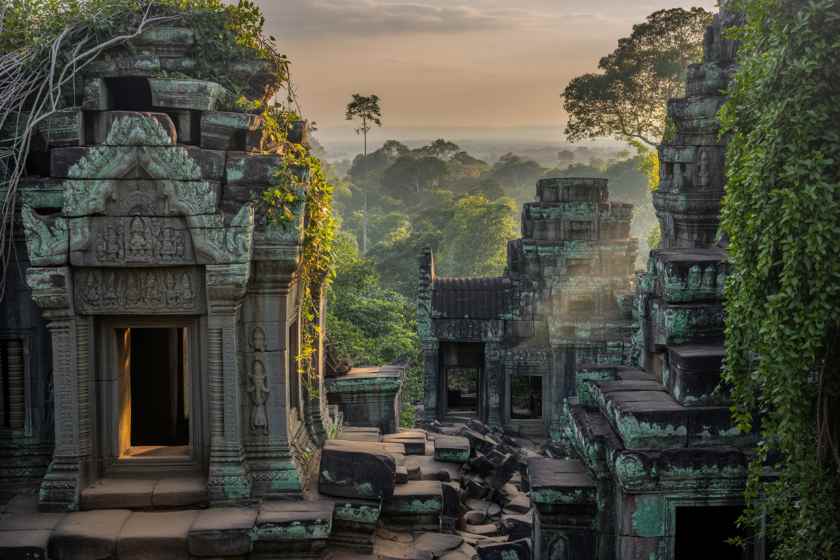
Angkor Wat—the planet’s largest place of worship—shines like the brightest jewel within the sprawling Angkor Archaeological Park. Commissioned in the early 12th century by King Suryavarman II as a shrine to Vishnu, the colossal complex peacefully transitioned to a Buddhist sanctuary over the centuries, quietly mirroring Cambodia’s layered history. Even today, the site epitomises the nation’s artistic and spiritual legacy, sheltered by slow-creeping jungle and golden dawn light. Its walls pulse with delicate carvings, its rooftops taper with skyward ambition, and its level courtyards gather stillness under a cathedral of living green.
Despite its monumental scale, visitors still feel the need to come closer. Angkor Wat sprawls in a manner that denies any intimate view in a rushed stride; one can linger for a dawn, yet sense unvisited corners echoing secret stories. Its corridors document, in sandstone and memory, the sprawling myths of the Hindu pantheon and the hopeful, ordered discipline of the Khmer Empire at its shimmering peak. The central spire, a sculpted mountain echoing the cosmological Mount Meru, dares the sky to keep its own towers. As one stands up there, the lift of 65 meters rewards the daring with a horizon of emerald rice paddies, smoking jungle, and the steady procession of monks and dawn.
Wandering through Angkor Wat, guests ascend the temple’s successive tiers, each tier revealing distinct designs and art forms. The broad outer galleries boast elaborate reliefs of the Hindu pantheon, while the core chamber cradles a tranquil Buddha, a silent testament to centuries of faith switching from the original Hindu cosmos. With its infinite beauty and echoes of the Khmer Empire, Angkor Wat continues to be Cambodia’s magnetic heart, luring millions of travellers annually. They come to gasp, wander, and absorb its layered narrative.
Outside the temple’s moat lies the even grander Angkor Archaeological Park, the sprawling cradle of the ancient capital itself. Encompassing more than 400 square kilometres, it houses a treasure of stone memory: the enigmatic smiles of the Bayon, the grip of roots at Ta Prohm, the pink sandstone prowess of Banteay Srei, and countless smaller shrines, reservoirs, and causeways. Every corner contains revelations, and the paths between the monuments let tourists drift through the echoes of an empire that once flourished here. The scale alone transforms a simple visit into a pilgrimage across a living memory.
Bayon Temple long ago captured the world’s imagination with its stone towers crowned by serene, enigmatic faces that seem to follow the light with every passing cloud. Nestled at the heart of Angkor Thom, the erstwhile capital of the Khmer Empire, its maze of corridors still hums quietly with the spirit of Khmer artistry. Luminous bas-reliefs recount secrets of the past, frozen in sandstone yet still stirring the heart.
Nearby, the haunting labyrinth of Ta Prohm courts the forest. Screened by twisting silk-cotton roots and wavering creepers, the cellars and galleries seem suspended in a moment between ruin and reclamation. With a steady hush, visitors who glimpse it are moved by the sorcery of the place, its shadowed silhouette woven into the action of celluloid history. Farther east, Banteay Srei emerges like an ember of crimson across a sea of verdant tranquillity. Its razor-sharp bas-reliefs and softly glowing pink sandstone shine with the work of artists who wielded tools like prayer beads. Here, every lapidary flutter of heart and eye is preserved in astonishing miniature, a palette of crimson, ocher, and dry brass shimmering beneath the muted golden sun.
The Influence of Zhou Daguan on Angkor Tourism
Zhou Daguan’s 13th-century depictions of Angkor—including vivid portraits of food stalls, shadowy courtyards, and moonlit mosques—quietly sculpted the global imagination of the Khmer capital. Although nearly eight centuries have elapsed since the envoy lulled the heat with words, the text has become an aerial command map for modern curiosity, guiding young adventurers and seasoned historians. In the domestic chronicles of Khmer daily life, attire, salt-monkey business, dread of mosquitoes, food pyrotechnics, and cooling incense, an intoxicating invitation for search and pilgrimage curls upward, centuries still glistening and ripe. Such visitors continue to fade restfully into the temple shadows, trading Zhou’s ink for chilled mineral water and cameras, tracking foot and gaze the way sutras once spread river to river.
This conversational walk across eight centuries anchors Angkor to a fluid present. In soft dawn light, the eastern colonnades of Angkor Wat still rise like the mirage Zhou first sketched with pats of silver dust and tapering palms, daring the centuries to reshape the ritual music. Visitors, some trailing tangle-eyed children, others wrapped in crisply ironed company sincerity, instinctively mimic the walk Dow Daguan described to watching, letting a dilation of time cushion them.
Tourism Growth and Preservation Efforts
With its sweeping history and extraordinary cultural importance, the Angkor Archaeological Park has solidified its place as a premier travel destination in Southeast Asia. Yet the site’s allure, while a vital booster to the local economy, generates equally pressing challenges, especially concerning site preservation. Ever-larger crowds have raised alarms about the potential consequences of constant foot traffic, humidity, and other pressures on the temples, each built of volcanic stone and requiring delicate, often weathered, balance.
To offset these risks, the Kingdom of Cambodia has joined forces with UNESCO and a coalition of trusted NGOs to mount a coordinated rescue campaign. Ticketing reforms set visitor ceilings in sensitive zones; archaeologists and craftsmen repair cracked lintels and Sagging roof beams with painstaking care. Activities once deemed peripheral, like shaded trail system design and community-led guesthouses, now steer daily movements into safe channels. These complementary moves seek to balance economic aspirations with the moral obligation to pass on the valley’s crown jewels to a horizon yet unseen.
Conclusion: A Timeless Destination for History and Culture Lovers
Angkor Wat and the surrounding area of the Angkor Archaeological Park encapsulate Cambodia’s extraordinary narrative of artistry, devotion, and enduring genius. Any traveller drawn to the shadows of once-vibrant empires soon realises that Angkor is not merely a collection of stones, but a sanctuary of memory. Gazing up at the soaring plastered towers of Wat, tracing the calming horizon of the bay at Bayon, or breathing the luxuriant silence that the trees have woven into Ta Prohm, one is enveloped in an atmosphere that breathes thousands of turning years.
As generations of wanderers have woven their stories into Angkor’s tapestries, successors of the early chroniclers—like Zhou Daguan, who painted the splendour of the site in the thirteenth century—still whisper their observations into the hearts of contemporary visitors. His luminous account, fragrant with the spices of perception, continues to lure inquisitive minds from every corner of the globe. This enduring literary companionship safeguards Angkor’s memory, assuring that today, as yesterday, the landmarks of the Khmer cosmos remain a magnet for those who wish to feel the quiet heartbeat of an ancient civilisation.

link