

<blockquote class=”body-blockquote”><strong>The Expert: </strong>I’ve spent my entire journalism career testing car electronics and have owned several radar detectors going back to the mid-90s. As editor of Car Audio & Electronics magazine, I coordinated an annual radar detector test and have kept my eyes and hands on the products ever since, keeping tabs on new technology and features. I’ve also tested enough detectors over the years to get a sense of what makes them good or bad based on their controls and feature sets. </blockquote><h2 class=”body-h2″>A Word of Warning</h2><p>Before explaining how to pick a good radar detector, I think it’s important to point out that radar detectors are not universally legal in North America. In the US, drivers are not legally allowed to use radar detectors in Virginia and Washington DC. They’re also banned in most Canadian provinces, including Manitoba, Ontario, Quebec, New Brunswick, Nova Scotia, Prince Edward Island, and Newfoundland. </p><p>The details of the laws vary from state to state, including the penalties for breaking them, but we would strongly recommend turning your detector off and putting it away while driving through states where they are banned. Highway patrol and police frequently use radar-detector detectors to sniff them out, so using a detector in a state where it’s illegal may actually increase your chances of getting pulled over.</p><h2 class=”body-h2″>What to Consider When Buying a Radar Detector</h2><h3 class=”body-h3″>How Radar Detectors Work</h3><p>Radar detectors allow you to find radar and laser signals used by law enforcement to measure vehicle speed. Using one feels like using an AM/FM radio: The receiver in the detector tunes into active radar signals, just like a radio tunes in to active radio station frequencies. In the US, law enforcement typically uses one of three radar and laser types–the X-, K-, and Ka-bands.</p><p>X band is the oldest form of radar used by law enforcement and is now uncommon. Its successor, K band, operates on a higher frequency and has lower power output, making it harder to more difficult to detect at long distance. Ka band has a narrower beam pattern and lower power output than both X and K band, making it the most difficult type of radar to detect at long distances.</p><p>Police laser guns emit short bursts of infrared light that reflect off a vehicle and return to the device. Unlike radar that can usually be detected in advance, police point lasers at a specific vehicle, so drivers don’t get advance warning.</p><h3 class=”body-h3″>Range<br></h3><p>If you’re looking to avoid a ticket, you need a radar detector that will notify you of an upcoming checkpoint far enough in advance for you to slow down if you’re speeding. That means your radar detector’s range effectively determines how useful it can be. Some detectors only track 100 feet away, where others can sense many miles away.</p><p>At the same time, it’s important to keep in mind that a detector’s effective range varies at any given moment, based on dense objects that could cause interference and even weather. Given that, many companies avoid telling you a detector’s range and lean on non-specific terms like “long range.” That said, we’ve tested the radar detectors on this to get a sense of their relative ranges and accuracy.</p><h3 class=”body-h3″>Antennas</h3><p>A radar detector’s antennas are like its “ears.” They allow the detector to search for radar and lasers in many different directions. The best radar detectors will have more antennas for detecting radar, which means you get better protection. Detectors with a single antenna only look for radar in front of a vehicle. More expensive models with multiple antennas can look behind and to the sides. The best of the best offer 360-degree detection, but full coverage is very expensive.</p><h3 class=”body-h3″>Visual, audible and voice alerts</h3><p>Different detectors have different ways of letting you know when they pick up a radar or laser signal. Some high-end detectors use voice alerts, which tell you specifically what’s coming. Others make specific sounds for each threat (X, K, Ka, laser) that you’ll need to learn. Most also have a small screen on the detector with visual guides that show you the radar type, the strength of the signal, and the direction where it’s coming from.</p><h3 class=”body-h3″>False Alert Filtering</h3><p>Radar detectors do sometimes pick up radar signals from other devices and mistake them for police radar guns. Anything from a radar-controlled <a href=” door opener</a> to a <a href=” could trigger a false alert–even adaptive cruise control on another car. Radar detectors use software to filter out frequent false alerts, learning where they frequently occur, and every one has a mute button so you can manually silence false alerts.</p><h3 class=”body-h3″>Highway and city modes (sensitivity and selectivity)</h3><p>Some detectors with longer range will feature a “city mode,” which reduces its sensitivity for city streets and more crowded areas. This allows you to reduce the potential for false alarms when you’re driving in a crowded area with more possibilities for interference and false alarms.</p><p>Some detectors also have a “highway mode,” which does the opposite–increasing its range, possibly at the expense of accuracy, so you can get more of a heads up when you’re most likely to need it… If you’re speeding. (But you’d never do that, right?)</p><p>Both of these modes adjust the detector’s selectivity, a related spec that refers to a detector’s ability to detect police radar while ignoring other radar sources that operate on neighboring frequencies. A detector with high selectivity can differentiate between radar and laser and other signals. The best radar detectors offer a good balance between sensitivity and selectivity, and use software to note spots with frequent false alerts and filter them out. </p><h3 class=”body-h3″>GPS</h3><p>Radar detectors with GPS give you the ability to mark and save the locations on recurrent speed traps and red light cameras so it can alert you before it detects a signal. More advanced models can access databases with crowdsourced trap and camera location data to give you more accurate warnings outside your everyday driving area, though you typically have to subscribe and pay an annual fee to access them.</p><p>Some detectors with GPS can also automatically switch between “city” and “highway” mode based on how fast you’re going.</p><h3 class=”body-h3″>Instant-On Protection</h3><p>Some police radar guns feature “<a href=” target=”_blank” rel=”nofollow”>instant-on</a>” radar, which shoots a quick signal burst that measures your driving speed before a radar detector could pick it up. Some radar detectors have a feature called “instant-on protection” that can detect instant-on radar if police use it on a vehicle ahead of you.</p><h3 class=”body-h3″>Smartphone app</h3><p>Some radar detectors can sync with a companion smartphone app, which unlocks additional features. Some allow you to mark speed traps and traffic cameras like you would with a GPS-enabled detector. App-based GPS may include additional information, like posted speed limits and real-time traffic alerts.</p><h2 class=”body-h2″>How We Tested The Best Radar Detectors</h2><p>To test these radar detectors, I <a href=” target=”_blank” rel=”nofollow”>rented a radar gun</a> and went to a deserted community-college campus in Southern California on a weekend. My assistant pointed a K-band radar gun at my test car, a 2017 Audi Q7, while I drove up a hill with a slight curve so that the vehicle would have to drive into the radar gun’s line of sight about 100 yards away. This gave me a sense of how quickly each detector could discover the radar signal, and most within a few feet of each other.</p><p>I also drove an urban loop to get a feel for how well the detectors pick up radar and false alerts and how well they filter them out. I also examined them while the car was stopped to fully explore the feature range of each detector, including their controls and user interface.</p>”/>


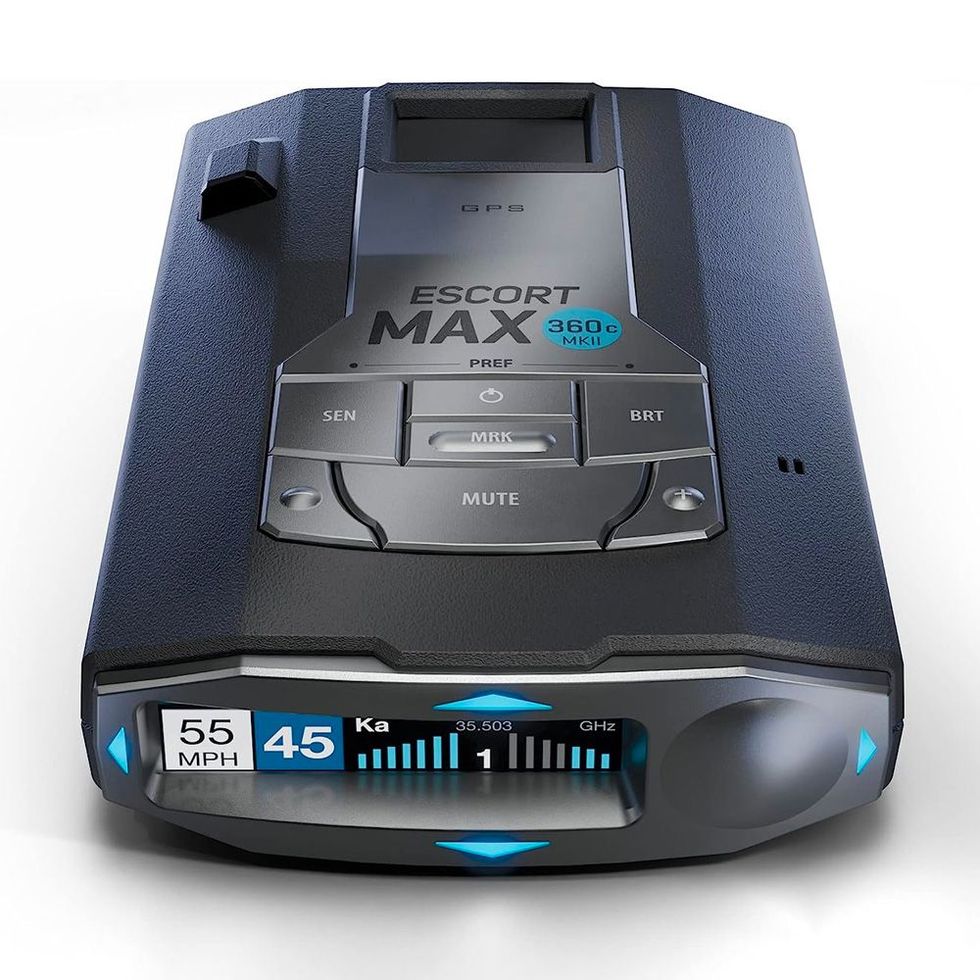
The Escort Max 360c MK II has two antennas for comprehensive, long-range protection. Intuitive controls make it easy to use, and an OLED screen with several color schemes and arrows that help you quickly identify a risk. GPS “auto-learn” pinpoints the location of frequent false alerts on your regular routes to block them. Likewise, it automatically adjusts its sensitivity based on your speed and shows posted speed limits.
You can customize the Escort Live app to give you more information, such as radar signal type and strength, by pairing it with your smartphone. Even without a phone, it features built-in WiFi so it can download traffic detection database updates automatically. Of course, you will need to pay a subscription fee after a three-month trial– either $24.95/year or $39.95 for three years. Even with the extra fees, though, its overall performance and feature set is unparalleled.
Key Specs
| Front and rear antennas | Yes |
|---|---|
| GPS | Yes |
| Smartphone app | Yes |

This affordable detector picks up radar from an impressive range of more than 100 yards in our test. It uses front and rear antennas to detect the core radar bands–X, K, and KA–and laser radar, while alert info is clearly displayed on a monochrome OLED display and voice warnings are available. Despite the preventative features, it still registers a larger than average number of false starts, but you can reduce it by fine-tuning the band setting if you can find out the specific frequency bands used in your area.
It also comes with plenty of impressive features, including GPS for low-speed false alert muting, the ability to manually mark up to 100 radar locations, and speed camera alerts. At this price, the Uniden DFR7’s performance and features are hard to beat.
Key Specs
| Front and rear antennas | Yes |
|---|---|
| GPS | Yes |
| Smartphone app | No |
Best for Beginners
Uniden DFR9
Best for Beginners
Uniden DFR9
Pros
- Adjustable radar sensitivity
- Multicolor display
- Voice alerts


Cons
- Clumsy windshield mount

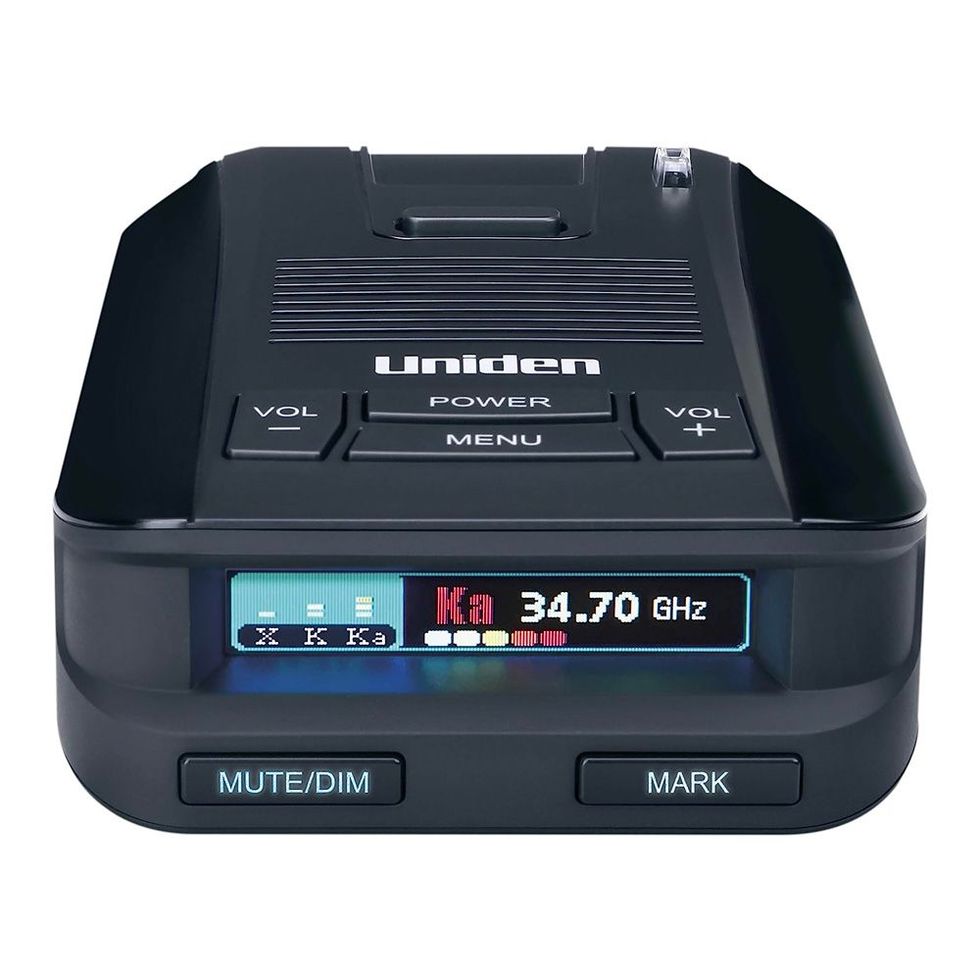
This slightly more feature-rich cousin of our Value pick is also considerably cheaper than most of our favorites, and it’s a great choice for any driver looking to pick up their first radar detector. The Uniden DFR9 also detects the three core radar bands, with 360-degree laser detection.
Its core features offer more depth, though: The GPS lets you mark cameras and traps, while identifying false alarms. The multi-color OLED display is a step up from the DFR7’s monochromatic display since it uses a broad color palette to show information. Lastly, it features many of my favorite bells and whistles, including highway mode, voice alerts, and a “Quiet Ride” feature that mutes alerts below a certain speed.
There is a catch. The suction cup mount that comes with the DFR9 didn’t work very well. That’s a comparatively small, fixable issue, for what is otherwise a solid radar detector that you can get for a very reasonable price.
Key Specs
| Front and rear antennas | Yes |
|---|---|
| GPS | Yes |
| Smartphone app | No |
Easy to Use
K40 Electronics Platinum100
Easy to Use
K40 Electronics Platinum100
Pros
- Comes with a remote control
- Customizable display
- One-on-one setup consultation support
Cons
- No smartphone app
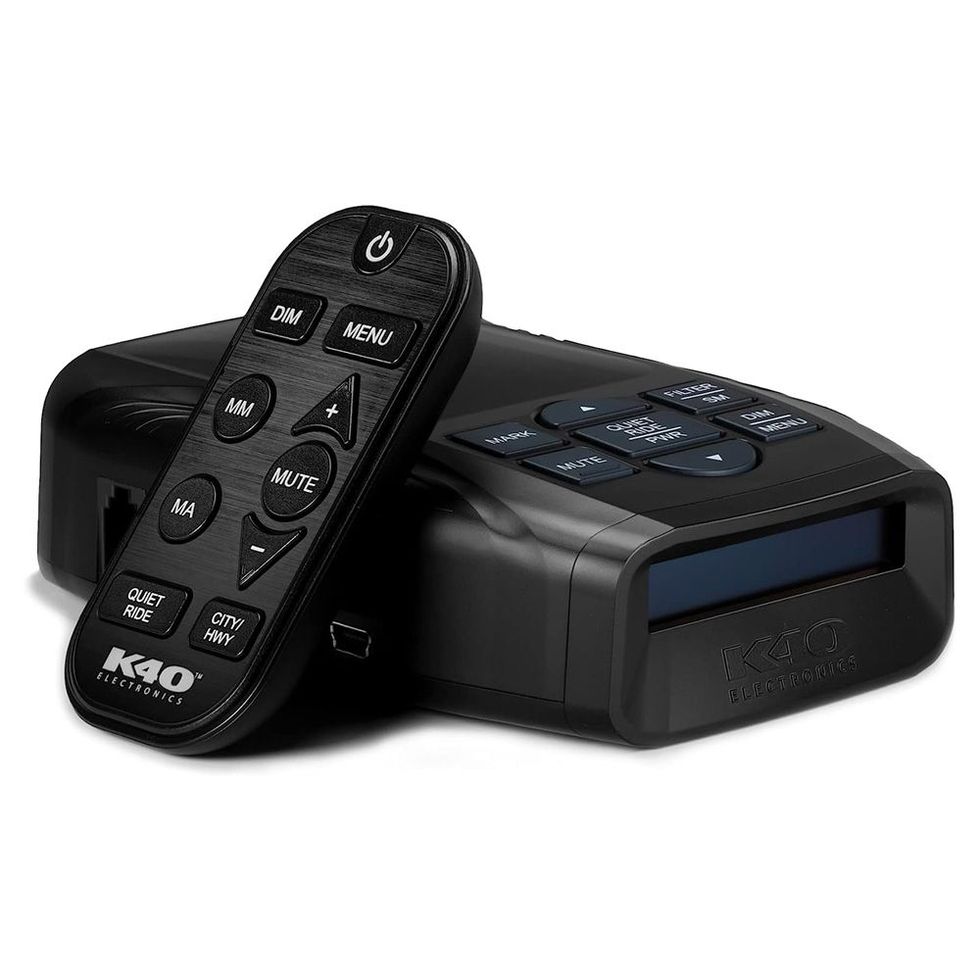
Almost all radar detectors share the same, very annoying flaw: You have to reach over to use the controls on the hardware, which is usually mounted on your windshield, whenever you need to adjust a setting. The K40 Platinum100 makes the issue much more manageable by giving you a remote control, so you can operate the detector without reaching. It also has a customizable display that lets you choose one of five color schemes.
Of course, it also provides solid protection from laser signals and radar, including frequency-shifting MultaRadar systems, which are harder to pick up. Last, but not least, it comes with a feature no other detector offers: 24/7 customer support and a one-on-one consultation with an expert from K40 Electronics to help you optimize the detector for your location unit and the way you drive.
Key Specs
| Front and rear antennas | Yes |
|---|---|
| GPS | Yes |
| Smartphone app | No |
Best for Motorcycles
Radenso DS1

Best for Motorcycles
Radenso DS1
Now 23% Off
Pros
- Customizable OLED display
- Free database access
- Mounting hole and 3.5mm headphone jack
Cons
- Frequent false alerts
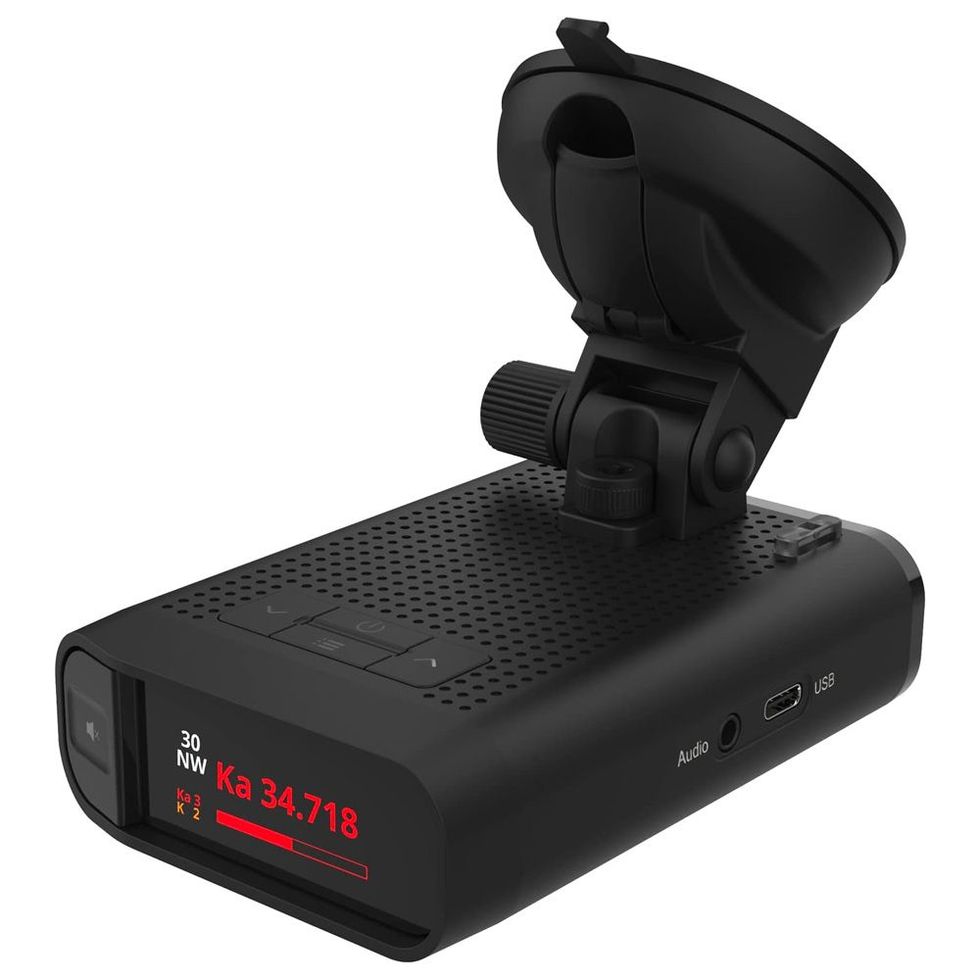
The Radenso DS1 is one of only a handful of radar detectors that you can easily mount and use effectively on a motorcycle. It features a 1/4-inch, 20 threaded mounting hole, so you can attach it to clamps and other accessories. It also features a USB-C port and 3.5mm headphone jack, so you can route its audio alerts to a headset or speaker.
This unit does not compromise on detection. It had one of the best radar detection ranges in our test, which is very helpful if you’re carving canyons in a car or on a bike, though it also issued more false alerts than detectors from the Escort Max 360c MK II and other top-of-the-line models.
Its color OLED display, which automatically dims in low light, is customizable, as are the audio cues for each type of radar band and laser.
The DS1 also features GPS and syncs to your smartphone via the Radenso app. Unlike most manufacturers, which charge an annual fee for access to their trap and camera databases, access to Radenso’s database is included.
Key Specs
| Front and rear antennas | Yes |
|---|---|
| GPS | Yes |
| Smartphone app | Yes |
Best With Dash Cam
Cobra Road Scout

Best With Dash Cam
Cobra Road Scout
Pros
- Doubles as a dashcam
- Sensitivity adjustments
- English/Spanish language support
Cons
- Short range
The Cobra Road Scout combines a radar detector and a dash cam into a single device, saving space on your windshield. The radar detector has a shorter range than our top detectors, but has solid features like speed-related sensitivity adjustment and GPS marking, including the ability to check crowdsourced stop light camera and speed trap locations using the Cobra iRadar app.
The 1080p, night-vision-enabled dash cam features continuous loop recording, with a g-sensor to detect a crash and start recording in an emergency. The Scout comes with a 16GB SD card, but you can always swap it out for a larger card.
Using the iRadar app, you can view, edit, and share recordings when desired. If you want the best of both worlds–or at least one device on your dash that can do double duty–the Cobra Road Scout won’t disappoint.
Key Specs
| Front and rear antennas | Yes |
|---|---|
| GPS | Yes |
| Smartphone app | Yes |
Q+A

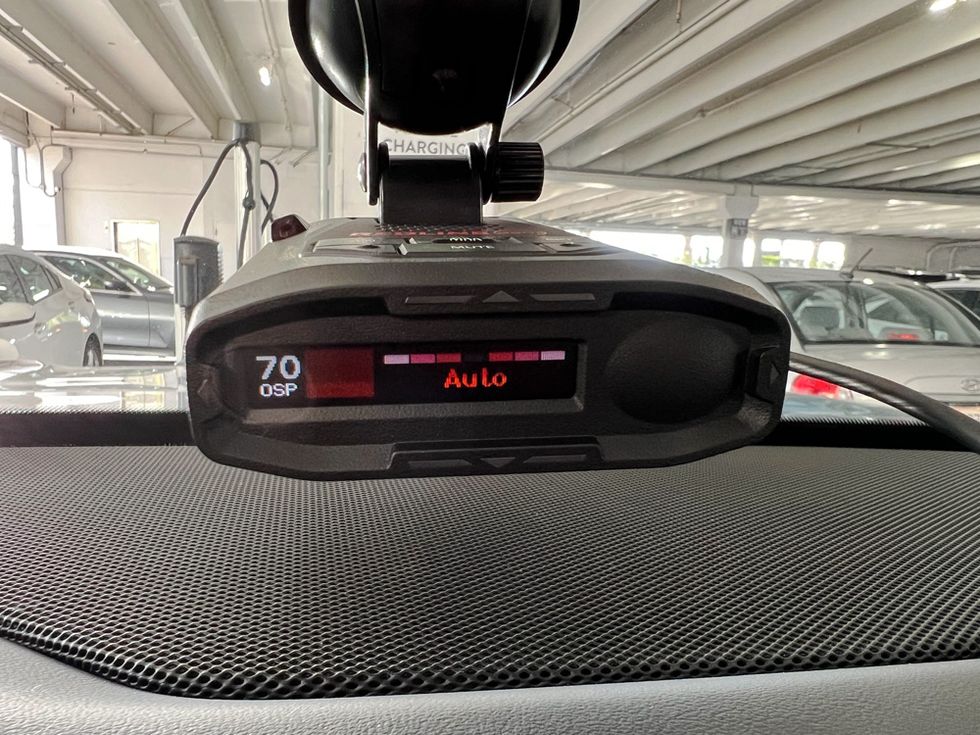
PM: Do police know if you have a radar detector?
DN: Many law enforcement agencies use radar-detector detectors, especially in areas where the devices are restricted or not allowed. Of course, they can also see your radar detector if you mount it on your windshield.
PM: What happens if I get caught using a radar detector?
DN: It depends on the jurisdiction. In Virginia, for example, drivers caught using a radar detector will be issued a $100 fine and police can confiscate the detector. Many US states, including California, New Jersey, and Pennsylvania, may issue a similar fine if you mount your radar detector on your windshield. (The fine is for using a windshield mount, not for the radar detector.)
PM: What’s the best way to mount your radar detector?
DN: That’s a tricky question. Mounting the detector on your windshield makes it easy to see, but can earn you a fine in many states. Each state has its own specific regulations on windshield mounting for radar detectors and smartphones.
In Oregon, where I’m from, the law says you can’t mount a device that obstructs your view–and I’ve never had a problem. In California, where I tested the detectors, a device must be mounted in a 7-inch square in the lower corner of the passenger-side windshield or in a 7-inch square in the lower corner of the driver’s side.
PM: Should I hide my radar detector when I’m not using it?
DN: I usually hide my radar detector. They’re very expensive, so leaving one out may attract thieves to break into your car. Many detectors come with a carrying case, and we like the ones with a convenient and quick-release magnetic mount.

Doug Newcomb splits his time between Hood River, Ore., and Todos Santos, Mexico. He’s been writing about technology and cars for more than 30 years for Wired, Rolling Stone, Road & Track, Automobile, PCMag.com, Playboy and numerous other publications. He cofounded the C3 Group in 2013 to produce automotive industry events in New York, San Francisco, Washington, D.C. and at SXSW in Austin. C3 Group was acquired by Informa in 2018. When he’s not writing, he’s riding a surfboard
Watch Next

Advertisement – Continue Reading Below
Advertisement – Continue Reading Below
link