
The name of Bangkok’s airport, Suvarnabhumi, means, as any Sanskritist knows, “Land of Gold”, while readers of historical fiction might recognise it as one of those prosperous overseas places the Cholas traded with millennia ago. That ancient land’s reputation reached as far as the Mediterranean where it was recorded, variously, as “Khryse Insula” or “Aurea Khersonese” by geographers who vaguely located it as an island or peninsula beyond the Ganges delta. Indian sources—say the Ramayana’s depictions of epic journeys or Buddhist texts about missionary work—place it in South-East Asia.
Academia still debates where exactly it might be located, but as a professional tourist, I wonder if I might be able to find it if I just poke around, and I figure Bangkok is as good a place as any to look for Suvarnabhumi. Never mind the earthquake that just shook the town the week before I land, but fortunately, my hotel has not crumbled and the terrapins by the garden pool take it easy.
Among the town’s must-sees are golden temples with gilded Buddhas, Khaosan Road’s bar-hopping backpackers, and the peccant ping-pong clubs of Patpong that attract peepers, but none of this makes me feel I am about to find any paradise around the next corner.
Walking upriver along the quays, trying to bring out the inner James Bond in me (recalling Roger Moore’s boat stunts in the movie appropriately titled The Man with the Golden Gun), I reach the National Museum. Among its treasures is a Roman-era lamp. That apart, there are no archaeological findings significant for my quest that dates back 2,000 years.
The India connection
My sightseeing is hampered by an unexpected Thai holiday, Songkran. Thousands of teenagers roam the streets armed with big water guns that make me think of Holi’s colour-squirting in India. That same day, I get a phone alert about Sankranti, and then the coin drops: this is a blend of old Hindu festivals still being celebrated even though the country is formally Buddhist. Yet the Ramayana holds a heritage status, the language borrows many words from Sanskrit, and much of the food is curry-based.
The cuisine is essentially a blend of two of the world’s great eating traditions, Indian and Chinese, though these influences are not necessarily old. Take the popular gaeng massaman, which translates as “Muslim non-vegetarian gravy with potatoes”: obviously an Indic-Arabic import of recent centuries, considering that potatoes did not make it to Asia before Columbus discovered them in America (while he actually was looking for a way to India).
Despite its current reputation as a culinary destination, Bangkok was a mere fishing village until 1782 when it replaced the upriver capital Ayutthaya (named after Ayodhya of the Ramayana fame). Even 100 years after that, it had only a few score curry cookshops, and it was only in 1957 that the city’s oldest Michelin-starred restaurant, Methavalai Sorndaeng, began dishing out the palace’s royal repasts to commoners. Sitting down to sample it, I am served a meal made for a mogul: rice soaked in flower-scented water with an array of delicate sides, deep-fried shrimp cakes, and a stupendous snakehead fish. Bearing in mind that the bill, including wine and beer, comes to only Rs.4,128, it is no wonder that gourmands pop over to Bangkok to binge eat.
Also Read | Tourific: A beginner’s guide to Bengaluru
The earliest Thai inscription, on a stone slab from 1292 in the National Museum, records what may be taken as their first dietary descriptions: “sour or sweet fruits that were delicious and good to eat… fish in the water, rice in the fields… coconut groves and jackfruit… mango groves and tamarind”. It sounds highly akin to the south Indian food range. But, and a big but it is, the kingdom was born around that same time in the 13th century, and besides, Thailand is neither an island nor a peninsula—it sits on a bay—so it was at most a stopover for that Roman who left his lamp behind in the museum.
Following in the Cholas’ footsteps
To find the enigmatic golden place of much hoarier yore, I move on. Cambodia’s massively bucket-listed Angkor Wat can be reached in less than a day by train from Bangkok, and after crossing the border, it is a three-hour taxi ride; it was easily done until mid-2025, but a simmering border war has turned the area into something of a pressure cooker. I would not recommend the overland route considering that Poipet, the border post I myself travelled through, was bombed while I was writing this story.
The vast Angkor complex was built from the 1100s onwards on the order of devarajas, or god-kings, many of whom had Hindu names while their shrines bear an architectural likeness to Indian temples. Hotels I stop at have names like Nawin and Sambath, which sound utterly Tamilian to me. The royal dances of Cambodia are derived from Indian temple dance, bharatanatyam in slow motion, I learn from a photographer who has spent decades documenting them, and the Buddhist priests that serve the royal family are oddly enough called Brahmins.
The archaeological site at Trowulan has yielded copious numbers of statues and inscriptions. At the well-curated site museum, one gets an in-depth look into the culture of the Majapahits. Pictured here, a statue of Narasimha, the man-lion avatar of Vishnu.
| Photo Credit:
Zac O’Yeah
And of course, there is more curry on my plate. In Cambodia known as khmer-kari, its rich coconut-milkiness, such as the fishy amok trey served in banana leaf cups, instantly brings Kerala to mind. Moving on towards Vietnam, curries do get subtler but are still recognisably called cari, only adjusted to local tastes and perhaps informed by French colonial cookery.
Just as Tamil temples can often be found along the Cauvery, Angkor’s temples were built by a lake connecting to the Mekong, though at 4,500 km, the river stretches five or six times the length of the Cauvery, providing ancient mariners access to numerous potential trading places inland.
Money was part of the game. I inspected samples of Roman coins at the brand-new SOSORO Museum of Money in Phnom Penh and later more at the History Museum in Ho Chi Minh City, better known as Saigon.
The two main sites where the currency was found, Angkor Borei in Cambodia and Óc Eo downriver from it in Vietnam, stand close enough so that from the hilltop Vishnu temple at the former, I see across the paddies another hillock marking the latter. But as they are separated by an international border, I must fly to Saigon and take a 500 km taxi ride through the fertile Mekong delta. Both are presumed to form the nucleus of Funan, the earliest known South-East Asian civilisation; with roots in the 1st century CE, its inscriptions show clear links between modern Khmer and India’s historical Pallava script.
A millennium before the Thais named their erstwhile capital after Ram’s birthplace, the Ramayana was already held in esteem among the Funanese and, eventually, the Khmers, who translated it as the Reamker, said to be the oldest version of the Ramayana outside India.
Spice route
Óc Eo may be a rural, rice-growing village off the tourist map but is unmistakably linked to both the Roman trade and India. A love for kari or cari runs deep, as evidenced by site museums on either side of the border having on display grinding stones for spices similar to those traditionally used in India. Science Advances reported in 2023 that even after 2,000 years, archaeologists “identified culinary spices that include turmeric, ginger, fingerroot, sand ginger, galangal, clove, nutmeg, and cinnamon” from an Óc Eo stone, which helps us imagine the taste of the first known dish in Vietnamese history.
Wallowing through museum after museum in Saigon, I finally sit down for a well-deserved foot massage behind the art-decoish Benh Than market (bit of a tourist trap to tell you the truth) and spot, across the road, a temple. It is a popular shrine where the Vietnamese worship the south Indian village deity Mariamman, but its detailing brings to mind the remains of those towering shrines from the Champa culture, another Indian-origin civilisation (named after the champaka flower) that arose in Vietnam during the 1st millennium CE. Maybe it is not as extinct as we tourists are led to believe? I journey by overnight train to Da Nang to explore Champa ruins, one of Vietnam’s more prominent tourist sights.
My Son, a sanctuary of Hindu temples, is the main evidence of Champa culture and impressive thanks to restoration work sponsored by the Indian government. But if you happen to meet a Cham today—the descendants are scattered in coastal Vietnam and inland Cambodia—he or she is likely to be Muslim. Overall, Vietnam is an almost perfect match for Suvarnabhumi… except for the lack of a peninsula or handy island.
***
At this point, it makes sense to fly five hours south from Hanoi to Bali, the “Island of Gods” and not any gods, but far-travelled Hindu gods—so a perfect suspect for the role of Isle of Gold. As it turns out, Bali is a blend of Goa and Marrakech, its most golden aspect being its sunburnt sands. Ubud, the island’s cultural capital, is crawling with digital nomads taking therapy at shops conspicuously named Chakra Converter and Yoga Soul.
Easily accessible on the outskirts of Yogyakarta, the Prambanan temple complex was built around the same time as the more famous Borobudur and is in fact more interesting to visit. Not only because Prambanan looks better on selfies but because the temples are covered with intricate carvings that narrate epics like the Ramayana (in picture).
| Photo Credit:
Zac O’Yeah
But as long as one avoids the vegan “Buddha Burgers” served at such places, Balinese cuisine turns out to be a feast of grilled suckling pigs, babi guling (a rare treat in Indonesia that is otherwise predominantly Muslim), and the ceremonial bebek betutu of char-grilled duck served at the foot of golden nasi kuning, a conical turmeric rice mound that symbolises the divine Mount Meru. Rice is also an object of worship in the form of the rice goddess Dewi Sri, but whatever the case, the meal leaves me with a sense of holy fulfilment.
Religious ties
The Balinese are very spiritual: every village has a temple called Pura Desa, each home a family shrine. In the yard outside the penthouse room I am renting for a week in Ubud, the landlady places floral offerings with a dish of rice, presumably for Dewi Sri.
At the modest archaeological museum that most tourists skip even if it holds objects that testify to a near-two-millennia-old culture, the staff is rapturous at having a visitor. Strolling through its pleasantly tranquil gardens, I come across lingams, votive stupas, and an Indian-style statue. As I try to determine if it depicts Buddha or a Hindu deity, the friendly attendant gets apologetic: “Sorry we lost the head. It is very old.”
Do you know what it is?
“In our Bali language, we call it a stone.”
What is it used for?
“Nobody knows, as it is very old. So, we don’t know because we are not so old. Do you know what these are?” he points at the museum’s famous prehistoric exhibits, heavy coffins of stone.
I say “sarcophagi”, which stuns him.
“How did you know?”
It says so on the sign.
“Oh. Have you heard of Greece?”
You mean Egypt? I subtly correct him as I have never seen sarcophagi in Greek museums, only in Egypt.
“Yes. And this here is Buddha’s sarcophagus; long time ago he lived in Taiwan; have you been to Taiwan?”
Yes, but I didn’t know Buddha lived there and died here.
“He did, in Angkor Wat. But that was long ago. Maybe a century.”
He must have mixed up Taiwan with Thailand, but I do not want to make him feel sorry so I do not point it out, as Angkor Wat anyway is in Cambodia.
Despite the museum’s lack of accurate knowledge, the links to India are getting stronger—and not only because Bali has a Hindu majority. Interestingly, a water-centred festival called Bali yatra is celebrated in Odisha in remembrance of sea journeys. A possible South-East Asian corollary is Javanese inscriptions referring to “Kling” traders, who came from Kalinga.
I take a taxi to Singaraja, a port on the north coast with, again, a very Indian-sounding name. Before the airport was built on the south coast, this was the entry point for tourists. Now the harbour is forlorn, with a handful of empty but decent seafood canteens where I lunch before hitting the town’s museum, which is even less visited than the one in Ubud. Here, I see more of those votive stupas that were displayed at the Ubud museum and ask the custodian where they are from. As it turns out, he is able to tell me about an unknown site—in the sense that it is not mentioned in a single tourist guidebook I know of—named Kalibukbuk, 8 km outside town, towards touristy Lovina beach. So, I request my taxi driver to take me there. It is a desolate spot, but serendipitously, the gate is open.
The restored Kalibukbuk was discovered as recently as 1994 when a swimming pool was to be constructed. It turned out to be a hitherto unidentified complex with a brick stupa from the 8th century—curiously adorned with a Ganesha apart from the expected Sanskrit inscriptions regarding the Buddhist core beliefs about dharma and karma. In my mind, this would logically be where those Odiyas doing the Bali yatra sailed to, especially as Bali’s richest archaeological site, Sembiran, is only 30 km away. It is where, presumably, royalty presided over business from a safe distance uphill. Archaeologists have found Indian pottery there, including shards with Kharoshthi characters.
I spend an hour in the compound but see no other tourist; it is clearly the most forgotten Balinese monument. Despite those primeval contacts with seafaring Indians, the bulk of its Hindu population seems to have found Bali a suitable refuge 500 years ago when the Majapahit empire collapsed due to the Islamic takeover of Java.
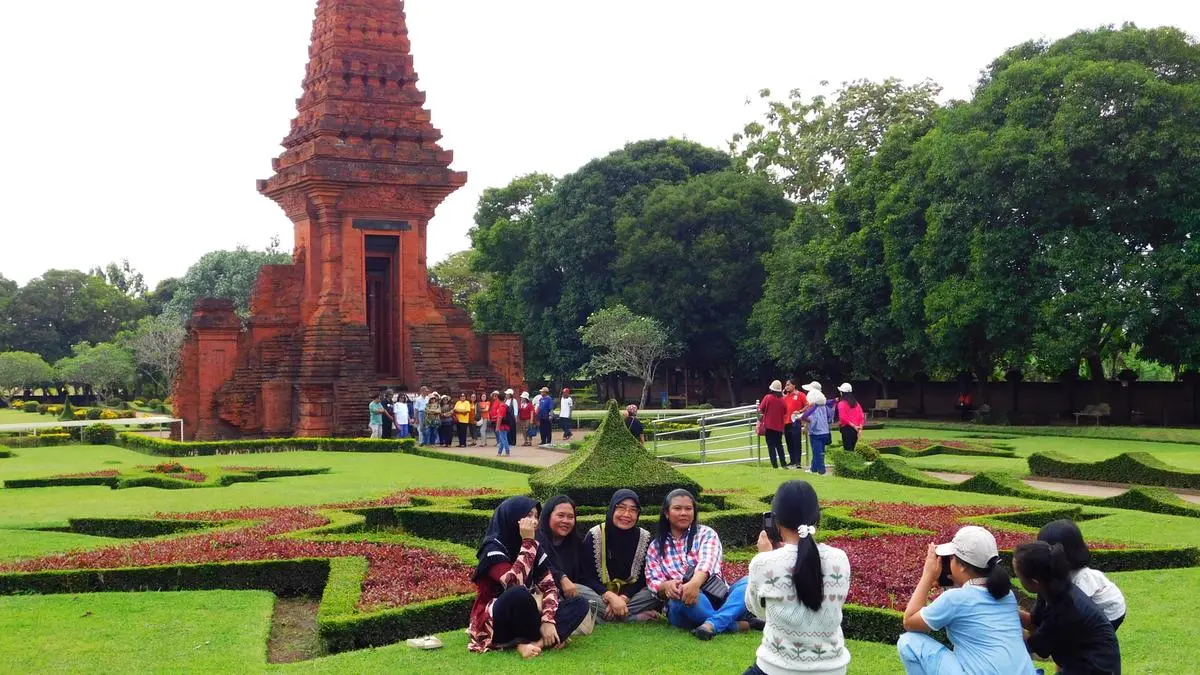
This empire was situated in eastern Java, so from Bali I take a boat for the short island-hop across a narrow strait. Opposite the shipping terminal is the railway station, from where a train—its pantry serving unexpectedly nice fried rice, the national dish of nasi goreng, with various scrumptious sides, making it almost like a thali meal, for dinner—takes me further west to Surabaya. The rundown harbour city roughly approximates the Majapahit port, 60 km downriver from its capital, which has been excavated at Trowulan, one of Indonesia’s finest experiences in my book. The archaeological area, covering about 99 square kilometres, easily deserves a full day of exploration as does its splendid site museum.
The path less trodden
Surabaya, founded 700 years ago and the gateway to Trowulan, turns out to be a delight, too. I instinctively take to it as I step out from my hotel after a breakfast buffet that showcases regional food and amble into a Chinatown around the corner. Temples thick with incense smoke. A short walk further takes me into an Arab kampung where an awesome souk leads to a mosque. Finally, across the river I find colonial quarters. Not another tourist in sight, but every inhabitant I speak to makes it a point to welcome me to Surabaya.
Rich but unspoilt heritage, and soon I wish I had booked more than a week in town. Google reaffirms that Surabaya is trending as the top undiscovered holiday destination; it also features as #34 on lists of the world’s best food cities and even hit the top 10 among budget-conscious destinations in 2025.
The toponymy of the surrounding scenery intrigues, as the island across the straits from Surabaya’s harbour is named Madura Island, after south India’s world-famous temple town Madurai, and interestingly, as if to squeeze in India’s sacred geography into Java, local lore has it that Mount Penanggungan, faintly discernible on the horizon as you drive out of town, is Mount Meru. (And I thought I just ate it in Bali!)
The family of the Javanese sultan of Yogyakarta runs two restaurants outside their palace where commoners can try the royal dishes. The way the rice is served in the centre is known as nasi kuning and is a precisely shaped turmeric rice mound that traditionally (among Indonesian Hindus) symbolises the sacred Mount Meru.
| Photo Credit:
Zac O’Yeah
The area’s Majapahit kings, whose heydays lasted from the 13th century to the 16th, were in turn preceded by the Sailendras, who leaned more towards Buddhism as their Borobudur monument, which is Indonesia’s most prominent tourist sight half a day’s train ride from Surabaya, shows. This dynasty can be dated to the period before Borobudur’s building and so we know that they ruled in the Yogyakarta area from the 7th century onwards.
This eastward movement of Indic power can be explained by how Islam gradually spread from the west until it became the dominant religion in the country that it is today. All these empires’ fortunes, whether sultans’ or rajas’, were based on the lucrative spice trade, exporting to both China and India, and unsurprisingly, Roman coins have been found in the river near Trowulan too, so one can safely assume that their opulent edifices were built with proceeds earned from cloves, mace, and nutmeg.
A bit of a let-down
Food is thus at the heart of almost everything in South-East Asia: history, religion, wealth. Although when I reach Yogyakarta, which everybody tells me is heaven, it turns out to be the opposite. Borobudur is underwhelming after the glories of Trowulan. Despite its tourist-trappy entrance fee of Rs.2,500 (in comparison, three sites at Trowulan cost Rs.75 in total), one was not allowed close enough to study the carvings, and with most of the light bulbs blown at the museum, one fumbled about in the dark.
I intended to indulge in food archaeology, but things did not work out. The sultanic family has two eateries by the palace where their favourite dishes are served. Nice grub, but the hype does not match my reality check. Since the sultan himself prohibited public drinking in town in 2024, one cannot enjoy the dining experience—even if their non-alcoholic bir djawa, essentially ginger beer, has an interesting flavour. Historians suggest that people had more fun in the taverns depicted on the temple carvings (if only we could just see them).
By far more stimulating (of Yogyakarta’s seeable sights) are the temples at Prambanan, decorated with motifs from the Ramayana, and way more instagrammable. Most tourists actually share reels of these that are about as old as Borobudur. Keep this as a secret, as I do not want to offend the Buddhas of Borobudur.
Appam-puttu-idli
The counter of a food stall in a local market becomes the most fascinating encounter in town: it holds something that looks like idlis but is called apem beras. They are sweet rather than sour and are made from fermented rice flour flavoured with coconut milk and palm sugar. As many of you know, there is a rumour that the idli is a result of the Chola overseas trade—even the BBC reported on the matter.
It would, if proven, be an interesting historical food link. But as much as I try to find a “kedli”—which the food historian K.T. Achaya theorises may be an Indonesian proto-idli in A Historical Dictionary of Indian Food—it never appears on my plate.
I discover something else called kue putu, which is like the puttu in Kerala; kue apem is the local name for appam, and a distinct idli-lookalike is kue cubit, roundish pancakes eaten for dessert and that appear to be a jazzed up sweetish cousin of the humble south Indian paddu! It is a complicated, multinational family tree we are facing here. And then there is the more idli-tasting, though chewier,ketupat, which comes with many Indonesian dishes as a side, fundamentally compressed rice dumplings cooked in a woven palm-leaf pocket.
Food items common in south India like paddus/paniyarams are found in Indonesia, where they became sweet pancake balls known as kue cubit. They reached Amsterdam via the colonial route and became poffertjes (in Dutch) and migrated to Scandinavian cuisine as æbleskiver (in Danish), krabbelurer (in Swedish), and munker (in Norwegian).
| Photo Credit:
Zac O’Yeah
However, even if the kedli-named idli supposedly was already enjoyed by the Sailendras and Majapahits, no idli was depicted on what I could see of the Borobudur monument that otherwise does show us that rice was important in those times. So, judging from the fact that the Indonesians have another Indian-origin dish known as idli-kukus, which basically is an actual idli, it sounds somewhat like they imported it from India, instead of the other way around. As far as we know, idli was first named in the old Kannada language where an “iddalige” is referred to as early as 920 CE, according to Achaya himself. I suspect he knew Indian food better than Indonesian, or possibly, someone told him that ketupat resembles idli but muddled it up and it was mistakenly noted down as “kedli”. If any expert on Indonesian cooking has tasted “idli-kedli” before that date, I would gladly stand corrected.
Meanwhile, I take a train to Jakarta, one of the most beautiful journeys within the country: the train rolls across paddy fields, past villages, and weaves its way around volcanoes that accidentally do not erupt as I pass underneath.
A good time in the most-crowded city
Most tourists dismiss Jakarta, but due to my gradually improving karma, I find an affordable hotel with good city views from the 15th floor in the Mango Bazaar, which is the food street straddling the borderland of Chinatown and the modern city. (Nota bene: Jalan Jaksa that used to be the backpacker area with cheap eateries and lodging has been usurped by development.) According to the latest UN calculations, Jakarta is the world’s biggest city, home to 42 million people. Even the Indonesian government finds it too big to handle and is in the process of shifting the national capital to Borneo.
Nonetheless, I end up having the time of my life—never mind the prostitutes in the lobby that keep asking if I need a massage. It is walking distance to all the museums, including the National Museum that burned down in 2023 but was luckily reopened a year ago. Although it is recovering from the calamity, many of the rooms are accessible and stuffed with fabulous stuff. The colonial quarters by the harbour are a pleasant walk north of my lodgings, with more interesting museums: a Maritime Museum details the sea trade, the Jakarta History Museum shows that the city is quite old, and finally the Museum Bank Indonesia, housed in an old bank as is obvious from its name, has exhibits dedicated to the Indonesian economy, including a strong room with a pile of gold where visitors are allowed to touch one gold bar. Yet, nothing that might single out Java as Suvarnabhumi.
I suspect that this story is losing its plot, but matters get worse when I leave Jakarta. I only have 10 days left on my visa but one more island to explore, and while packing my bags, I get a message that a volcanic eruption has hit flights. Especially at the Bali airport where I just was, followed by a magnitude 5.9 earthquake in south Sumatra where I am headed. The latter reminds me of the deadliest tsunami, in 2004, with waves also hitting Indian coasts and killing a quarter million people worldwide.
A double whammy if there ever was one, and as I sit on the bus, which takes forever to leave Jakarta’s expansive suburbs, I think that my journey is going to end badly. I consider cancelling, but it is late at night and I fall into an uneasy slumber. More of a nightmare, in truth. By midnight, the bus rolls onto the ferry to cross the Sunda Strait, and our driver tells me if it sinks, he cannot allow me to sleep in the bus. I climb to the upper deck where the lifeboats are. What have I gotten myself into?
As I watch the lights of Sumatra’s southernmost port flicker in the tropical night, I tell myself to focus, and by dawn, the bus deposits me outside a sad railway station from where only one train departs daily—to Palembang. Arduous seems like an understatement by the time I reach my hotel, an unassuming but friendly lodge auspiciously named Sriwijaya99 just off the city’s main streets where they know no English as nobody ever comes to Palembang, so we communicate through their translation app.
Marco Polo and Alexander the Great
Even if tourists generally avoid Sumatra, which is regarded as difficult (cannibals, highwaymen, you name it), Marco Polo visited the island in the 1290s and discovered the wonders of sago, used to make a type of pasta that may have been the origin of spaghetti, some say. Before that, local people claim that Alexander the Great had—after reaching India in 326 BCE—continued his journey further east and was in fact buried here. Considering that his tomb has never been found in Alexandria or any of the other cities where I have looked for it, why not here?
At least it is pointed out to me, along with tombs of other kings, on the locally hallowed mountain, sacred to the Srivijaya civilisation based out of here in the 1st millennium; it is also thought to be the birthplace of Malay culture. Gold was mined in the highlands upriver from Palembang, and large numbers of antique gold treasures have been found by fishermen in the city itself. The town, visited by about 0.015 per cent of the tourists who land in Bali, has surprisingly inspiring museums, including one named after local king Balaputra—who happens to be written about in an inscription at Nalanda in Bihar. History also links Srivijaya to the Nagapattinam port in Tamil Nadu as a major trading partner more than a thousand years ago.
It simply cannot be dismissed as a potential candidate for Suvarnabhumi. Especially if one starts jiggling and juggling one’s Sanskrit, Sumatra…Samudra, an island across the ocean. Where else could those olden sailors have gone looking for lands of gold?
Vietnam celebrated the 50th anniversary of the end of the “American War” —or what the rest of the world calls the Vietnam War—in 2025, and the map of independent and undivided Vietnam was visible everywhere in the country, including on the traditional silk dresses known as Ao Dai (in picture).
| Photo Credit:
Anjum Hassan
Scholars have countered such ideas, claiming that there are other more prominent places: like Jambi where I stop over on my way north but which feels like a Johnny-come-lately in this great game.
Travelling by bus across the island, which I discover too late is one of the world’s biggest and yet hardly has motorable roads, is taxing. I did try to hire a taxi, but no driver was willing to go even after I offered them astronomical sums (but not as much as the price of a new car). I end up sitting night after night on ramshackle buses stinking of poop and puke, with routine breakdowns causing endless delays. It is primitive travelling: there is no information on the Internet, one must rely on hearsay, believe in good luck and, if possible, avoid bad.
Coming full circle
I reach, after 1,250 km on the island’s virtually non-existent roads, a nondescript port city on the Strait of Malacca. Breathing out on the rooftop of a wonderfully welcoming hotel in Dumai, after having booked my ticket on a speedboat for the next day and thinking I shall survive this too, I chill with beers. Suddenly back in the modern world, I focus my gaze on Malaysia somewhere ahead.
In the morning, my boat takes off in a tropical storm—a last scary moment that makes boarding the rocking vessel challenging. Looking through the window of the speedboat at a slow oil tanker carrying “black gold”, I hum some half-remembered tune and after a while recall Neil Young’s lyrics that go with it, “searching for a land of gold”, no, I am wrong, it goes “searching for a heart of gold, and I’m getting old”, but while I do hope to grow old, I do not necessarily want to chase this story until I lose my mind.
Also Read | Dien Bien Phu at 70: Blood-soaked battlefield that became a bustling township
Am I going around in circles? Certainly, I will have completed a circumambulation of South-East Asia by the time I step ashore on the mainland as Malaysia shares a land border with Thailand, so I am almost back where I began this journey, and then suddenly it strikes me: maybe this is Suvarnabhumi?
Hold that thought. It is said that a long time ago the Strait of Malacca business began as piracy and then developed into trade facilitation via a mix of diplomacy and tariffs. No wonder the port of Melaka, founded by a Srivijaya king and earlier known as Malacca, was named after the Moluccas, the fabled Spice Islands beyond Bali.
Sumatra and Malaysia, an island and a peninsula, both inhabited by Malays and once under Srivijaya control. Does that not sound almost logical? Even though separated by the narrow Malacca Strait, they are practically one country—Malaysian food is closely related to that of Sumatra—except that they occupy two opposite coastlines. The sky clears as in just a few hours we arrive in Malaysia, and after nights of poor sleep on headache-inducing buses, my brain is finally crunching data again. Our possible flaw in trying to pinpoint the Golden Land is that we are looking for it on land, but perhaps we ought to look for it at sea instead? It is not a too long stretch for an imaginative geographer to accept.
I mull on this as I recuperate in Melaka, a delightful town where—again—Indian culture has left an imprint. There is an area called Little India with “Madrasi” restaurants and on the outskirts a “Chitty”—Chettiyar—settlement with a tiny museum and a mini-Goa where the Catholics, known as Kristang, eat vindaloo and drink in the afternoons. Back in the old days, local people subscribed to the first newspaper published in Tamil in the 1880s, Swadesamitran, and which was posted by ship from Madras. Looking back, it is as if I never left India but moved through its outlier aspects through these travels.
Zac O’Yeah never uses AI in his writing, so you can always be sure that his texts are originals.
link